
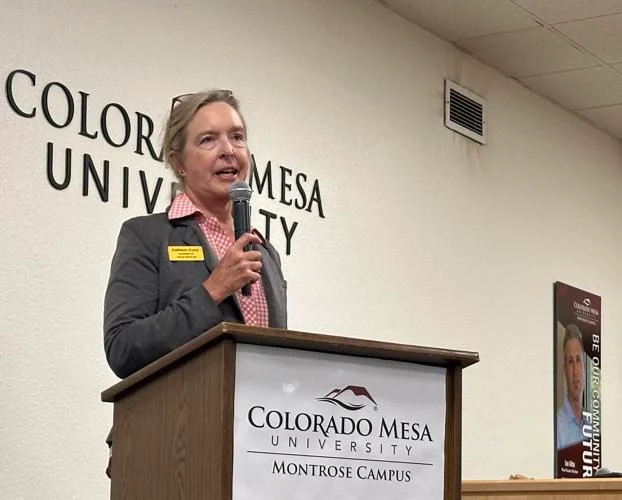
Kathleen Curry, a former Democratic state legislator from Gunnison, is hoping to return to Denver and represent D58 in the House. (Jeremy Morrison / Montrose Daily Press)
As far as stumping goes, The Forum at Colorado Mesa University’s Montrose campus is a pretty good opportunity. It provides candidates with what Rep. Marc Catlin points out is a highly engaged pool of attendees.
“Thank you for coming today,” Catlin told the crowd assembled for The Forum on Wednesday, Oct. 9, during which candidates seeking office across the Western Slope were given a chance to make their pitch. “I’m proud of you for taking the time today to come and find out who the people are running for the offices that you’re going to vote for. That shows your engagement, that shows you matter, that shows that you are thinking about what we’re saying up here.”
The Forum actually presents a golden, unchallenged and unfiltered opportunity for regional candidates, an opportunity to not only relay their policy positions, but also to convey their political philosophy and establish Western Slope street cred, and on Thursday Larry Don Suckla, running for the House District 58 seat, wasn’t wasting his opportunity, instead working his stump speech up into Yosemite Sam-levels of blister, talking about Denver’s “assault” on Western Slope interests — “they’re not very friendly to Ag up at the state house, they’re use to their concrete jungle” — and leaning into partisan jabs — “I am sick and tired of the Democrats” — as well as his rural roots and values.
“I don’t want to go up there and live in that concrete jungle,” Suckla told attendees to the candidate forum. “I’d rather go back to my ranch, where I can go out there and see wildlife and everything — I don’t know how much wildlife there’s going to be once they get the wolf over here and they eat all the deer and the elk. Maybe that’s their plan, they want to get rid of all of our wildlife. I don’t know what their plan is to be honest with you.”
Eventually, Suckla would work his way around to the same common issues that each of the candidates would hit during their allotted minutes before The Forum crowd, the issues that his D58 opponent Kathleen Curry would identify as two of her primary points of focus, two of the main issues she hears about when traversing the Western Slope campaign trail.
“There’s a common thread, even though this is a diverse district and a big district. Everywhere I go people talk about the high cost of living in this part of the state, and also their concerns about water resources,” Curry said during her appearance at The Forum.”Those two seem to be coming up nearly everywhere.”
Who will succeed Boebert?
Colorado’s 3rd Congressional District features an interesting race with plenty of backstory and national political allure. Democrat Adam Frisch and Republican Jeff Hurd are both looking to snag Rep. Lauren Boebert’s seat in congress. Frisch was originally looking at a rematch with Boebert — a race he narrowly lost last time around — before the congresswoman jumped districts prior to the Republican primary, opening the door for Hurd to slip onto the ballot.
Frisch — a former city councilman From Aspen — was first up. As he often does, the candidate waxed poetic about putting in the miles campaigning across the Western Slope with what he describes as a “father-and-son road trip,” and also recalled his Boebert-inspired origin story: “We ended up having the closest race in the country.”
The Democrat also stressed that he was a Democrat of a certain variety, a Western Slope-focused, rural Democrat that could see beyond partisan politics or the leftward sway of Denver.
“I just don’t have any room left over for partisanship. I think that both parties — I would say that neither party has a monopoly on good ideas, and that both parties have some very, very bad ideas,” Frisch said. “If there was a get-stuff-done party, I’d be on the get-stuff-done party. To me, it’s not about being on Team Democrat or Team Republican, it’s about being on Team CD3.”
Frisch also hit the two primary themes embraced by most of the candidates at the forum: water and the cost of living.
“It’s very important to make sure that the Western Slope water stays on the Western Slope. We do not want to solve Colorado’s water shortage on the back of CD3,” the candidate said, nodding the inner-state water discussion between the Western Slope and the Front Range, before nodding towards the Colorado’s conversation with other western states when it comes to the Colorado River. “We also do not want to solve the seven-state Colorado River compact on the back of Colorado — some of you probably know, but Colorado is the only state in the Lower 48 that only has water flowing out. We’re the only state in the Lower 48 that doesn’t have water flowing in. So, it’s really important that we make sure that water stays here.”
“There’s this view from Denver and D.C. that because we don’t live in big cities, things are just cheaper,” Frisch said, moving on to cost-of-living issues. “It’s quite the opposite. We have fewer options for groceries, we have fewer options for healthcare, we have fewer options for childcare. And we need to figure out how to produce more housing for the people that live here.”
Next up, Hurd, a lawyer from Grand Junction, also dug into the issue of water and Western Slope interests — “Ag is the backbone of our economy and that is something that I will work hard to do everyday, is to make sure … that we keep the water that our farmer and ranchers need to grow our food” — as well as leaning into issues like border security and, like his opponent Frisch, domestic energy independence.
The Republican candidate also emphasized the contrasts between urban and rural interests in Colorado and elsewhere, saying he would be a voice for CD3’s rural values.
“There are two Colorados. One Colorado is in the north metro area, and there they import jobs and opportunity and money. And in the other Colorado, we export our kids,” Hurd said. “And we are being left behind in rural Colorado. And I’m running fundamentally to create economic opportunity so that our children can, if they want, stay and live and thrive in the other Colorado, in rural Colorado. ”
Having grown up “just up the road” in Grand Junction, Hurd also told the audience at The Forum that it was nice to be in Montrose, where he felt “at home.”
“This feels like being at home, frankly,” the candidate said. “Being here makes you feel like you’re at a neighbor’s house. You feel comfortable, you feel at home.”
Dreaming of District 58
The candidates to take the floor at The Forum were those in the House District 58 race, Democrat Kathleen Curry and Republican Larry Don Suckla. Curry, from Gunnison, is a former state legislator, while Suckla is a former Montezuma County commissioner; both candidates have experience in the agriculture and ranching industries.
Curry told the Montrose audience that she decided to run for the D58 seat to ensure that the Western Slope had an “effective voice” in Denver, and because she has “a love for the legislative process.” The former state lawmaker — who served three terms as a Democrat, before an unsuccessful bid as an independent candidate — said that her decision to run solidified when she realized Rep. Marc Catlin, a notable voice on the region’s agricultural and water issues, would be term-limited and unable to seek reelection.
“I thought, I know how to do this job, I know how to do it well, I can’t sit this one out, there’s too much at stake,” Curry recalled.
Curry said that her “dream” scenario would be to win the D58 seat and then be appointed to serve on the Committee on Agriculture and Natural Resources, which she once chaired.
“When you serve in that position — as Representative Catlin knows — you can really help guide the direction of legislation that runs through that particular committee,” Curry said. “My hope is that if the voters send me back to the capitol as their representative, my hope is that I would be appointed to a leadership position on that committee again.”
The Democrat also said she would like to focus on the issue of water infrastructure in the region, and perhaps the legislature could more actively incentivize affordable housing projects.
“There is a state role in that, I think, and I just wanted to share my philosophy on that,” Curry said, regarding the issue of affordable housing incentives. “I don’t have a specific idea for legislation right at the moment, but I can tell you what I would support, and that would be incentivizing the construction of additional housing that would be more affordable for the citizens of this state, and then also trying to not get in the way of that — sometimes what the General Assembly does actually creates a disincentive.”
Incentivizing affordable housing was a topic Suckla hit upon as well. The Republican candidate blamed the lack of affordable housing on the cost to connect such developments to infrastructure such as water and electricity systems, as well as the prioritization of open spaces.
Suckla distilled his views on government’s role in incentivizing affordable housing — he’s against the concept — into a stream-of-consciousness, punctuation-defying, fast-paced speech that recalled his past as an auctioneer.
“In Telluride right now they’re having a problem with affordable housing — they did it to themselves!” Suckla said, explaining how the town had prioritized open space over affordable housing. “Now all the sudden they’re like, ‘Hey, we don’t have no place to put affordable housing.’ And it’s, like, yeah you don’t have no place because you made that all open space. That’s why you have no place, you did it to yourself. So, do I want to use my taxpayer money — it’s called subsidized housing, that is the word that it is: for subsidized housing. Do I want to take these farmers’ hard-earned money — and the citizens in Montrose County — and use their money to make it to where somebody can live in Telluride — where we all want to live; it’s beautiful, is it not? — no I don’t want my hard-earned tax money to go to that, they need to figure it out theirselves, they are an elite class, use your elite money and build your affordable housing, and then leave us farmers and us ranchers alone so that we can live our lives the way that we’ve been living — we’ve been doing a pretty good job! You wanna know why it’s so beautiful here? It’s because of all of us in the room, that’s why it’s so beautiful here. And we care where we live and we take care of where we live and we don’t need those bureaucrats here on the other side of the hill telling us how to manage our land — I am Larry Don Suckla and if you’re sick and tired of what’s been going on for the last three and a half years then vote for me. Thank you.”
No silver bullets, only patient incrementalism
Next, candidates from the District 5 state senate race spoke. This is the seat that Catlin, a Republican from Montrose, has shifted his attentions to since running his course in the House. Running against the Republican is Cole Buerger, a Democrat who was raised in Garfield County.
Listing off the familiar issues of water and housing, Buerger said he was ready to focus on solutions: “What are our ideas? Rather than just identifying problems, what are our ideas to get things done in Denver?”
“There’s no one silver bullet, but I have a few ideas,” the candidate said, expressing an interest to explore housing incentives and to focus on Western Slope infrastructure needs.
For his part, Catlin spoke about his experience in the House and made a case it was easily transferable to the state senate: “I’ve been your state rep for eight years. I think you know who I am.”
The Republican said that if elected he would focus on legislation particularly pertaining to the District 5, and work to get bipartisan buy-in from legislators from across the state. Catlin also noted how methodical the job of a state legislator can be and said he was prepared to chip away at his longer-term legislative goals.
“When I first went over to Denver I thought, ‘I’ll go make some big changes, we’ll be alright,’” Catlin recalled. “Well, you find out you can’t make big changes, you do them in incremental pieces. It may take you four or five years to get to where you want to be.”
In addition to these state representative races, candidates from several other races that will appear before Montrose voters also spoke during The Forum’s Oct. 8 event. Candidates from in the District 3 State Board of Education race — Ellen Angeles and Sherri Wright — addressed attendees, as did local Montrose County commissioner candidates Scott Mijares, running unopposed for the District 1 seat, and District 3 candidates Republican Rick Dunlap and independent Tricia Murray.
To view a video of the candidates’ pitches at The Forum, visit The Forum’s Facebook page.
 Jeremy Morrison is the managing editor for the Montrose Daily Press.
Montrose Daily Press | October 12, 2024
View original article